
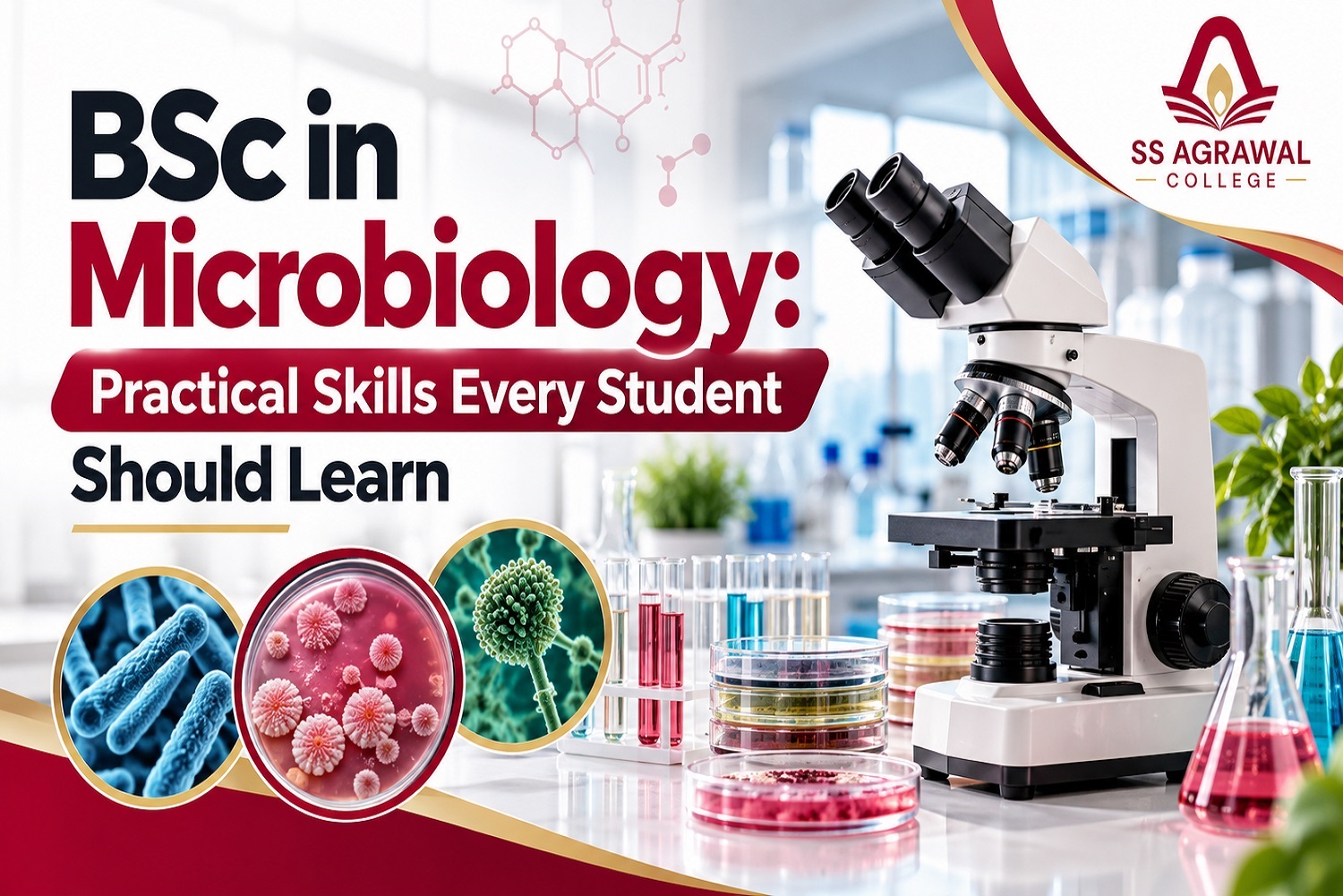
A BSc in Microbiology is not something you can learn by reading books. Microbiology is a science that you learn by doing. Students understand the subject better when they use lab techniques, watch life forms, run experiments and see how science works in real life. For people who want to work in health care, medicine, labs, food, research or the environment, learning skills is an important part of getting ready for a job.
At S. S. Agrawal College in Navsari, the B.Sc. Microbiology course focuses on learning through experiments. The college has lab space, up-to-date tools, teachers who know their stuff and chances to do research, get internships and work with companies. The course also includes things like microbiology, biochemistry, genetics and immune systems.
So what skills should a microbiology student learn during a BSc? Here are some of the important ones.
1. Microscopy and Slide Preparation
Microscopy is one of the basics of microbiology. Students need to get used to making slides using microscopes and looking at things under different levels of zoom.
Being able to see the shape and structure of these life forms helps students match what they learn with what they see in the lab. Making slides also teaches them to be careful and clean when working.
2. Microbial Culturing Techniques
Learning how to grow organisms is a big part of microbiology. Students learn how to choose the mix for growing them, how to handle samples and how to watch them grow.
This kind of knowledge is useful in areas like research, hospitals, food labs and factories. It also helps students learn to follow rules and keep the lab safe.
3. Staining Techniques
Staining is another lab skill. Students learn ways to color tiny life forms so they are easier to see and tell apart under the microscope.
Learning how to do this takes patience and attention to detail. Small mistakes can change what you see. This habit of being careful is very useful in labs and hospitals.
4. Laboratory Safety and Good Working Practices
Science is not just about knowing the steps. Students also need to learn how to stay safe in the lab.
A good microbiology student learns how to use tools to keep the lab clean, label samples properly, throw things away the right way and follow safety rules. These habits seem small now. Become more important as students move into real jobs.
5. Sample Handling and Observation
Microbiology is about looking at samples and seeing what happens. Students need to learn how to collect, label, handle and watch samples in a way.
Good observation skills are very important. Microbiology often depends on seeing differences. Students should write down what they see by relying on memory.
6. Basic Biochemistry Skills
The B.Sc. Microbiology course at S. S. Agrawal College includes biochemistry as well as microbiology, genetics and immune systems.
Understanding how chemicals work helps students see how tiny life forms interact with their surroundings and how reactions work. Students need to connect what they learn in books with what they see in the lab. This helps them in jobs like drug making, creating products, food processing or research.
7. Genetics and Molecular Thinking
Modern microbiology is connected to genetics. How things change. Students need to learn about genes, how they pass on how they change and how life forms vary.
Even if students do not plan to do research this knowledge can help them in studies or special areas of science.
8. Data Recording and Interpretation
A lab experiment is not over when the results are seen. Students also need to write down what they find and understand what it means.
Learning how to read data helps students see patterns, compare results and talk about what they found. Keeping a lab book is also a good way to build good habits.
9. Research and Problem-Solving Skills
One of the goals of the B.Sc. Microbiology course at S. S. Agrawal College is to help students get better at thinking and solving problems. The department also offers projects, internships and chances to work with companies.
Doing research teaches students how to find answers when the path’s not clear. They learn to ask questions, plan tests, look at results and think about why things happen. These skills are useful no matter what job they choose.
10. Communication and Scientific Presentation
Students do not just need to know how to do experiments. They also need to learn how to talk about what they find.
Explaining an experiment, sharing results, making a report or talking about research needs words. Students who can mix science with speaking and writing may find it easier to work in school projects, jobs or professional settings.
Practical Learning at S. S. Agrawal College
The BSc in Microbiology course at S. S. Agrawal College is about learning through doing. The college says its labs have tools to help students practice real lab techniques. The course also has teachers who have experience in both teaching and research.
The department also does more than regular classes. They take students to places like Sula Vineyards to see how science works in life. The teachers have done research. Written about their work.
These experiences help students see how what they learn in class is used in the world.
Where Can Practical Microbiology Skills Take You?
Learning skills during a BSc in Microbiology can help students go into many different areas. According to the S. S. Agrawal course graduates can work in research, hospitals, labs that check the environment and places that make sure products are safe.
Jobs can be in companies that make medicine labs that make products, places that process food, hospitals, places that test for diseases, groups that protect the environment and places that do science research.
Students can also go on to studies after their BSc. S. S. Agrawal College has an M.Sc. Microbiology course is one of the choices for students who want to keep learning.
Final Thoughts
A BSc in Microbiology gives students the chance to learn about life forms and how to work in a lab. Skills like looking through a microscope growing organisms, coloring them, staying safe in the lab handling samples, reading data, doing research, solving problems and talking about science can make the learning experience much better.
For students who want to go into microbiology choosing a course that mixes classroom learning with lab time is a good choice. At S. S. Agrawal College, in Navsari, the B.Sc. Microbiology course brings together microbiology, biochemistry, genetics and immune systems with lab work chances to do research and real industry experience.
In the end the purpose of a microbiology degree is not just to remember facts. It is to learn how to watch, test, think, ask questions and use science—skills that can help students in their studies and jobs long after they finish school.