
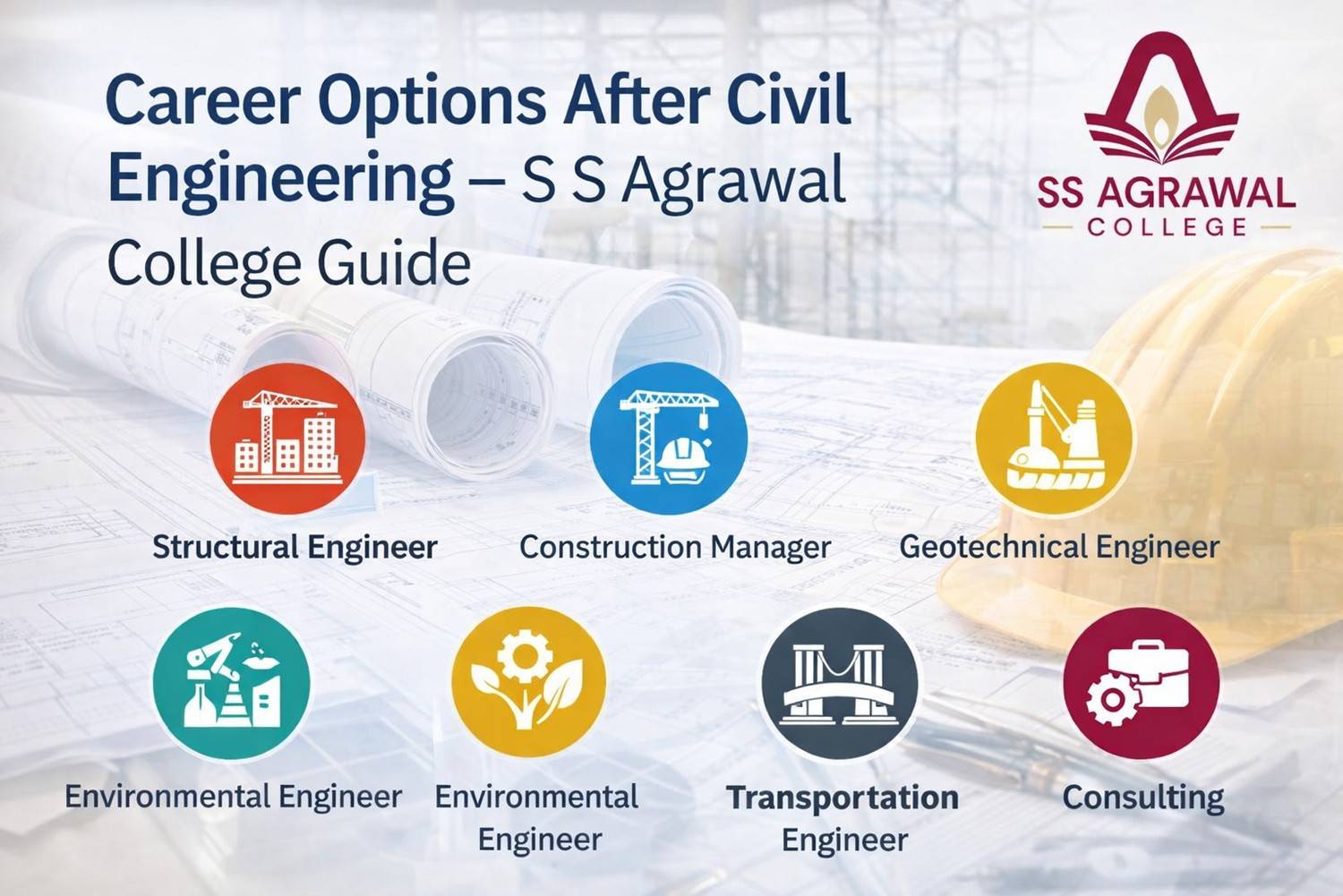
One of those careers where you are able to see the results of your efforts standing tall for ages is Civil Engineering. Any infrastructure that keeps a city or town operating, including roads, bridges, buildings, and water systems. It’s usual to wonder exactly what happens next if you’re a student of civil engineering or have recently graduated. It’s hardly a shiny list of “dream careers.” It’s a practical guide based on what our students at S S Agrawal College in Navsari have experienced and where the opportunities really are in 2026 and beyond.
Why Many Still Choose Civil Engineering
India’s infrastructure development drive has not stalled. Water projects, urban reconstruction, metro lines, and new roadways continue to provide jobs. Despite fierce competition, government initiatives and commercial development provide consistent demand. Although the work isn’t always simple—sites can be hot, dusty, and demanding—those who enjoy making things and solving actual issues find the work to be fulfilling.
We endeavor to prepare students at our college by incorporating theory, practical laboratory knowledge, and exposure to real building sites. Many former students report that having practical experience made it easier for them to transition into the workforce more quickly.
Main Career Paths Most Graduates Take
1. Government Jobs
A lot of our students aim for this because of the stability, regular salary, and benefits. Departments like Public Works (PWD), Indian Railways, Municipal Corporations, Irrigation, NHAI, and CPWD regularly hire civil engineers.
Common entry routes:
- SSC JE (Junior Engineer)
- GATE (for PSUs or higher posts)
- State PSC / Engineering Services exams
- RRB JE for railways
It’s competitive, no doubt. Many start preparing from the third year itself, balancing college with coaching or self-study. The payoff is job security and a structured career. In-hand salary for a fresh Junior Engineer often starts around ₹45,000–60,000 per month (depending on city and allowances), plus other perks.
2. Private Sector Jobs
Private companies can offer faster growth and sometimes better initial pay in good firms, though early years often mean long hours on site.
Typical first roles:
- Site Engineer (supervision, execution)
- Junior Structural Engineer
- Project Coordinator
- Planning or Quality Engineer
You’ll see openings with construction giants, real estate developers, infrastructure firms, and consultants. Companies like L&T, Tata Projects, Shapoorji Pallonji, and many regional players hire regularly. Our students who have done well in projects and software tools tend to get shortlisted more easily.
3. Going for Higher Studies
Some graduates prefer to specialize before jumping into the job market.
Common choices:
- M.Tech in Structural, Geotechnical, Transportation, Environmental, or Water Resources Engineering
- MBA focused on Construction or Project Management
- MS programs abroad (if you’re aiming for international exposure)
This route can open doors to design offices, consultancy firms, or research roles. A few students work for a year or two first, then pursue higher studies with clearer goals (and sometimes company support).
4. Entrepreneurship
Sometimes our grads go on to create their own real estate development companies, contracting traditional firms, or structural design and project management advisory services firms. Many people find running their own business to be exciting, but it often requires a few years of industry expertise and strong networking. Through some project work and workshops, we encourage students to consider this.
5. Core Specializations
You can focus more carefully on subjects like:
- Structural engineers (construction of buildings, bridges, and structures)
- Geological (foundations, soil mechanics)
- Connectivity (highways, roads, and traffic)
- The environmental (sustainable systems, water management)
These often become clearer during final-year projects or while pursuing M.Tech.
6. Emerging Areas That Are Gaining Ground
The field is changing with technology and sustainability needs.
Some growing opportunities:
- Smart city projects (using data and sensors for better urban planning)
- Green and sustainable construction (energy-efficient buildings, eco-friendly materials)
- Building Information Modeling (BIM) for 3D digital planning and coordination
- Use of AI tools for project scheduling and risk management
We introduce students to these concepts so they’re not completely new when they enter the industry. BIM skills, in particular, are becoming a big advantage.
7. Teaching and Research
If you enjoy academics, you can prepare for lecturer or assistant professor positions in colleges, or join research organizations. A Master’s or PhD is usually needed. It’s a different pace — more stable hours and the chance to keep learning and teaching the next generation.
Skills That Actually Help You Succeed
Technical knowledge alone isn’t enough anymore. Employers notice when you can:
- Work comfortably with AutoCAD, STAAD Pro, or similar design software
- Do basic surveying and understand drawings on site
Plan and coordinate small teams
On the personal side:
- Clear communication (especially explaining things to contractors or clients)
- Problem-solving when things don’t go as planned on site
- Ability to work in a team and handle pressure
We focus on these through practical labs, mini-projects, and industry visits.
Salary Expectations in 2026
Salaries vary a lot by location, company, and your skills:
- Freshers in private sector: Often ₹3–6 LPA (site roles can start on the lower side)
- Government/PSU entry (via SSC JE or GATE): Generally better with allowances — in-hand can be ₹45,000–60,000+ per month
- After 4–6 years: ₹8–15 LPA is common in decent private roles; government scales move steadily with promotions
- Senior/project manager level: ₹15–30 LPA or more, especially in consultancy, large infrastructure, or specialized skills like BIM
Private jobs can grow faster if the company is doing well, while the government offers predictability and benefits that add up over time. Some alumni have also explored opportunities in the Gulf for higher tax-free packages after gaining a few years of experience.
How Things Look Ahead
Civil engineers will still be relevant because of India’s concentration on developing roads, metro networks, smart cities, and green infrastructure. Fresh kinds of job duties are also being created by the issues of resource efficiency and climate resilience.
Students often adapt better when they combine an excellent basis with hands-on learning and some digital capabilities.
Conclusion
Civil engineering isn’t a glamorous desk job every day. There will be dusty sites, tight deadlines, and moments when you question your choices. But when you drive over a bridge or walk into a building you helped create, it hits differently.
Whether you chase government stability, private-sector growth, further studies, your own business, or teaching — there’s space for different personalities in this field.
At S S Agrawal College, we aim to provide students with a strong foundation and education for the real world so they can successfully pick their career. Kindly get in contact with our faculty or placement team if you’re considering civil engineering or if you’re already interested in it and are undecided of what to do next. We would be pleased to offer more realistic guidance based on the experiences of our learners.
Building the future is more than just a catchphrase; it’s a laborious but potentially extremely fulfilling endeavor.