
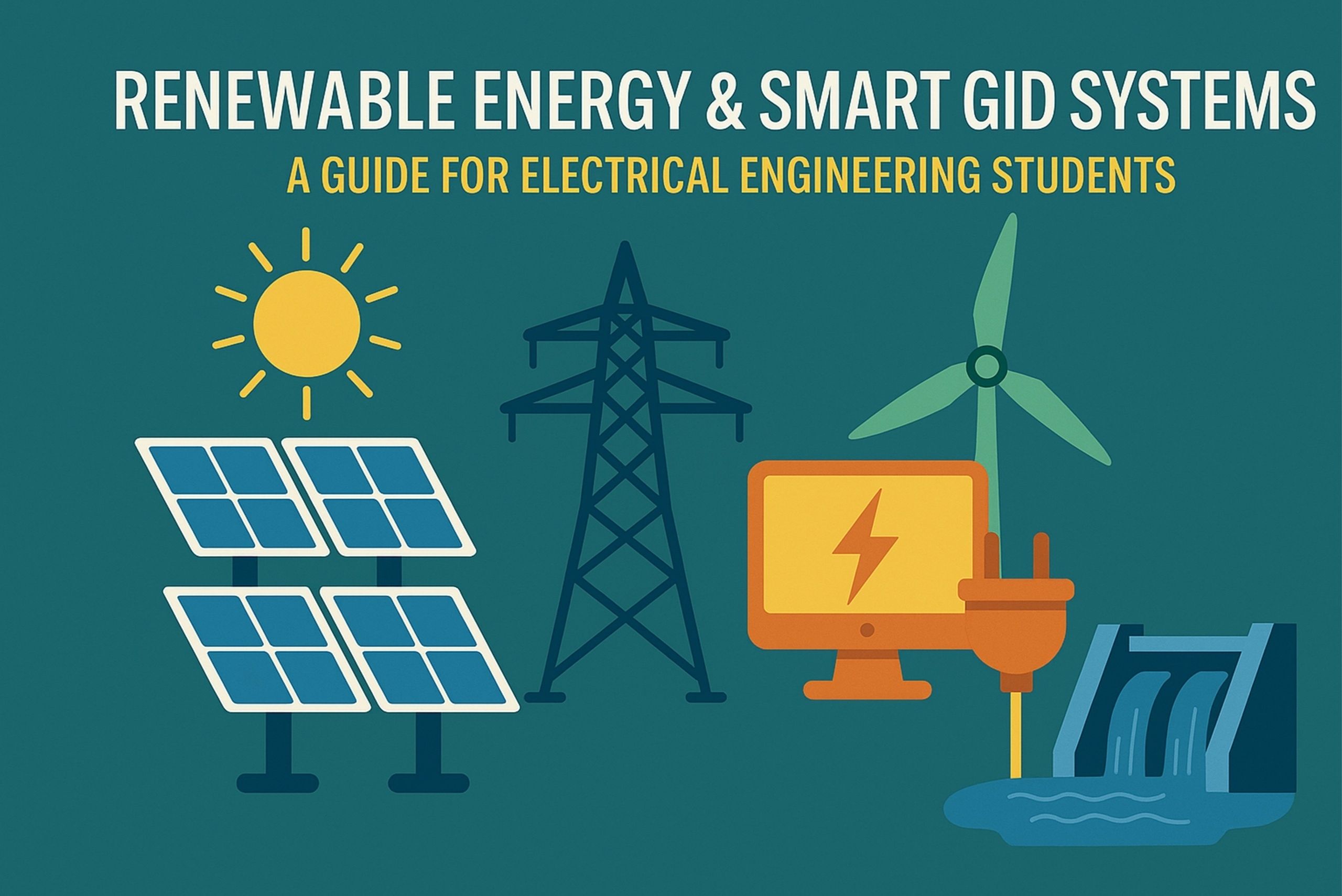
The world is changing fast when it comes to energy. We’re all hearing more about climate change, skyrocketing electricity bills, and the push to go green, and right in the middle of it are renewable energy and smart grids. If you’re an electrical engineering student, this isn’t just another chapter in your textbook; it’s literally the future you’re going to be working in. Companies can’t hire skilled engineers in these areas fast enough, and the projects you’ll get to work on are genuinely exciting. So let’s break it down in a way that actually feels human, not like a copied brochure.
What Exactly Is Renewable Energy (in Plain English)?
It’s energy that comes from sources nature keeps refilling: the sun that rises every morning, wind that never really stops blowing, rivers that keep flowing, heat trapped deep inside the earth, and even organic waste we’d throw away anyway.
The big ones you’ll deal with are:
- Solar: those panels on rooftops turning sunlight straight into electricity
- Wind: giant turbines out at sea or on hilltops
- Hydro: dams and runofriver plants
- Biomass: burning or gasifying agricultural waste, wood chips, etc.
- Geothermal: pulling steady heat from underground
Unlike coal or gas, these don’t run out and they don’t choke the planet with CO₂. Your job as an electrical engineer? Making them work reliably and cheaply? That’s on us.
So What’s This “Smart Grid” Everyone Keeps Talking About?
Think of the old power grid as a oneway street: power plants push electricity out, it travels through wires, and you just hope nothing breaks. A smart grid is a twoway, intelligent highway.
It knows in realtime how much power is being generated by millions of rooftop solar panels, how much your AC is pulling right now, and whether a tree just fell on a line in the next suburb. Then it reacts instantly—reroutes power, tells your water heater to chill for 10 minutes, or even pulls energy back from electric cars parked in driveways.
Cool features you’ll actually design one day:
- Sensors everywhere talking to each other
- Automatic fault detection (the grid basically “heals” itself)
- Letting homeowners sell extra solar power back to the utility
- Huge battery banks that store wind down excess wind power at 3 a.m. for the morning rush
Why You Should Care (Spoiler: Jobs + Impact)
The numbers are kind of insane. Millions of new jobs are coming in the next decade, and a huge chunk of them need people who understand both power systems and modern tech. We’re talking sixfigure salaries in many countries before you hit 30, plus the feeling that your work is actually fighting climate change.
Some roles you could land:
- Designing the control systems for a 200 MW solar farm
- Building the software that keeps the grid stable when half the country suddenly plugs in their EVs
- Consulting for cities that want to go 100 % renewable
- Optimizing massive offshore wind projects
Skills That Will Make You UnemployableProof
Forget memorizing formulas just for exams. Companies want these right now:
Power electronics (inverters, converters—everything that makes renewables play nice with the grid)
- Control systems and PLC programming
- Energy storage—lithium batteries, flow batteries, supercapacitors
- MATLAB/Simulink, PSCAD, ETAP for simulation
- IoT, a bit of Python, and maybe even machine learning for load forecasting
- SCADA systems and cybersecurity (because nobody wants the grid hacked)
Pro tip: places that have actual labs where you can wire up a small wind turbine or program a real PLC beat pure theory every time.
What Electrical Engineers Actually Do on These Projects
We’re involved from day one:
- Picking the right inverter for a solar plant
- Making sure a wind farm ride through voltage dips without disconnecting
- Designing microgrids for remote villages or military bases
- Writing the algorithms that decide when to charge or discharge a 100 MWh battery
- Making sure the grid doesn’t collapse when the sun goes behind a cloud
With smart grids, we’re building systems that detect a fault, isolate it, and restore power in seconds—all without a human lifting a finger.
How to Actually Get Ready While Still in College
- Take every elective you can on renewable energy, power electronics, and control systems.
- Beg/borrow/steal internship spots—six months on a real solar or wind project beats a 4.0 GPA.
- Learn the tools: MATLAB, ETAP, Homer Pro, AutoCAD Electrical, and at least basic Python.
- Go to workshops, hackathons, and conferences—even the small local ones.
- Grab certifications (NABCEP, smart grid certificates, etc.)—they’re gold on a fresh resume.
Final Thought
Look, ten years from now nobody is going to be hiring coalplant engineers. But the world will desperately need sharp electrical engineers who can design, build, and run the clean energy system we should have built decades ago.
If you’re studying EE right now, you accidentally picked the perfect time. Renewable energy and smart grids aren’t just “trendy”—they’re the biggest infrastructure buildout of our generation. Jump in, get your hands dirty in the lab, and you’ll be part of something that actually matters.
The grid of the future isn’t going to build itself—and it’s waiting for people exactly like you.