
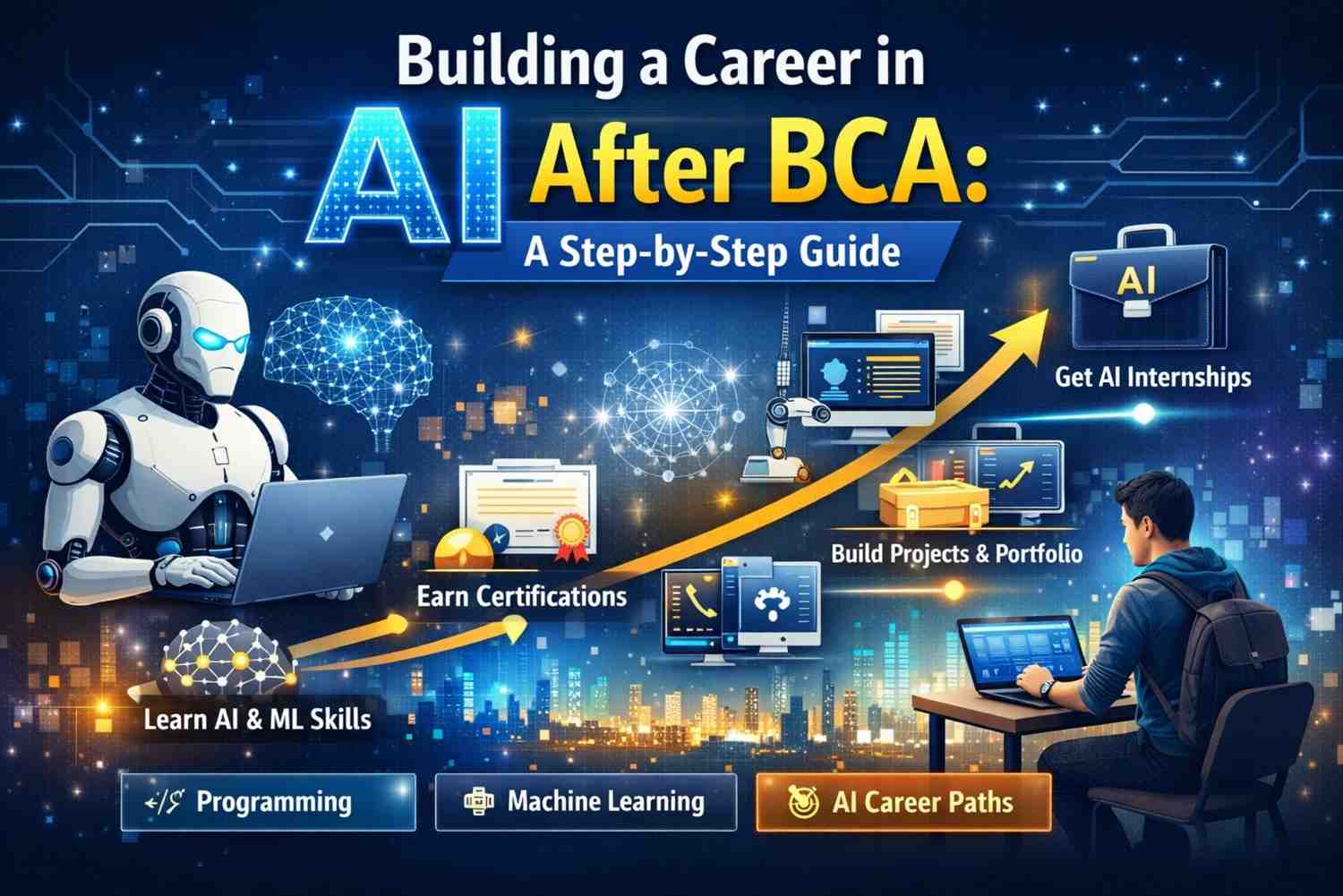
AI is changing a lot of things, such as shopping online, health care, finance, and even education. People who are getting or have already gotten their Bachelor of Computer Applications (BCA) can find exciting and fast-growing jobs in AI. BCA graduates can have a successful and fulfilling career in AI if they have the right skills, certifications, and plan. This guide shows you how to do it step by step.
Why AI Is a Good Job After BCA
BCA gives you a good foundation in how computers work, programming, databases, and making software. These basic skills are great for AI jobs like making smart apps, learning how to use machines, and looking at data. The need for skilled workers keeps growing as more and more businesses use AI-powered solutions. This means that AI is one of the best jobs you can get after BCA.
Step 1: Find out more about the basics of coding
The first step to working in AI is learning how to code. Because you graduated from BCA, you already know C, C++, Java, or Python. There are a few things you should pay extra attention to if you want to work in AI. For example, Python is the language that most people use for AI and ML.
- Structures and Algorithms for Data
- How to Use Objects in Programming
- Ideas for databases and SQL
If you know a lot about Python libraries like NumPy, Pandas, and Matplotlib, you’ll be able to get jobs in AI and data science.
Step 2: Learn about AI and machine learning.
You can start learning the basics of AI once you are more comfortable with your programming skills. This means you need to know how computers learn from data and make guesses. Keep these things in mind:
There are three main types of learning in machine learning: supervised, unsupervised, and reinforcement.
- Fundamental concepts in statistics and probability
- Fundamental concepts in linear algebra
- Checking and making models better
There are structured ways for BCA students to learn more about these topics, such as online platforms, university workshops, and certification programs that focus on AI.
Step 3: Learn about some parts of AI
AI has a lot of different parts. After you learn the basics, choose a field that interests you:
- As a Machine Learning Engineer, your job is to make ML models better and better.
- Data Analyst or Data Scientist: uses data insights and predictive analytics to do their job.
- AI Developer: adds AI to software
- Natural language processing (NLP) is used for things like recognizing speech, chatbots, and analyzing text.
- Computer vision is the study of how to use photos and videos.
Picking a specialization helps you figure out what you want to learn and makes you more appealing to employers.
Step 4: Make portfolios and projects that are useful.
If you want to work in AI, you need to get real-world experience. Employers care more about being able to solve problems in the real world than just knowing theory. If you’re a BCA student or graduate, you should work on AI projects of all sizes.
- Use examples and datasets from the real world
- Upload your work to GitHub.
- Make a list of the project’s goals, tools, and outcomes.
Chatbots, tools for analyzing sentiment, recommendation systems, and models for making predictions are some of the most popular AI projects for beginners. It is much easier to find work if you have a strong portfolio.
Step 5: Get certifications that will make you better at your job.
Certifications prove that you have the skills you say you do and make people more likely to trust you. After BCA, AI-focused certifications can help bridge the gap between what schools teach and what businesses need. Check to see if the person is certified in AI.
- Learning with computers
- The Science of Data
- Python for AI
- Cloud services that include AI tools
Recruiters will like your resume more if you have certifications from well-known schools and platforms.
Step 6: Get internships and real-world experience
Internships are a great way to start working in AI. They let you use what you’ve learned on real projects, see how things work in the field, and meet other people who work in the same field. Graduates of BCA should actively look for internships in AI or data analytics.
- Things to do with groups or teachers
- Programs that train people who work in the field
- Working with new businesses
- Even short internships can help your AI career a lot.
Step 7: Consider going back to school or taking a class in a certain subject.
You can get into AI with just a BCA degree, but many students go to college to get better jobs. You can get an MCA that focuses on either AI or data science.
- A master’s degree in AI or machine learning
- PG Diploma in AI and Data Science
- You can get better jobs, do research, and become a leader in AI with a higher degree.
Step 8: Get ready for AI job interviews and jobs.
If you want to work in AI after you get your BCA, you need to get ready for technical interviews. Improve your coding and problem-solving skills.
- Pictures and ideas about how machine learning works
- Details about the project
- Being able to talk and think critically
Once you get your BCA in AI, you could work as an AI Analyst, a Junior Data Scientist, a Machine Learning Engineer, or a Software Developer who knows a lot about AI.
Conclusion
What will jobs in AI be like after BCA? AI is getting better and better and being used in more and more places. As long as BCA graduates keep learning and getting better at their jobs, they can expect to have strong career growth, competitive pay, and global opportunities in AI-driven roles.
In short, you can get a job in AI after BCA, and it’s a very rewarding field. If you want to work in AI after getting your BCA, you should improve your programming skills, learn the basics of AI, pick the right area of study, get some experience, and get certified. If the next generation of tech workers is dedicated and has a clear plan, AI could be a great career path for them.